

 Write an Email
 Share
ShareLondon’s most haunted places are concentrated in the ancient City of London — a square mile where a confirmed Black Death burial ground lies beneath Charterhouse Square, William Wallace was executed at West Smithfield in 1305, and England’s oldest prison gave the language the word “clink.” Beyond that core, the Tower of London, Highgate Cemetery, and 50 Berkeley Square carry their own weight.
Charterhouse Square and West Smithfield
The burial ground beneath Charterhouse Square was established in 1348 and confirmed by Crossrail DNA analysis in 2013–2014, with Yersinia pestis identified in skeletal remains. Two hundred metres north, West Smithfield served as London’s primary public execution ground for centuries. A memorial on the wall of St. Bartholomew’s Hospital marks Wallace’s execution site; a separate plaque commemorates the Protestant martyrs burned under Mary I — approximately 48 specifically at Smithfield, per historian Virginia Rounding’s “The Burning Time.” Ghost Tour London departs from Charterhouse Square every night at 8PM.
(Further reading: Smithfield’s dark history)
Is the Tower of London Haunted?
The Tower has over 900 years of documented history as a royal palace, prison, and execution site. Anne Boleyn was executed on Tower Green on 19 May 1536. Catherine Howard followed in February 1542. The Princes in the Tower disappeared within its walls in 1483; their fate remains undocumented. The ghost stories attached to this record are Victorian legend — the documented history does not need them. Historic Royal Palaces typically programmes evening events in October; check hrp.org.uk for current availability.
Highgate Cemetery and 50 Berkeley Square
Highgate Cemetery, established in 1839, divides into two sections. The East Cemetery is open daily to independent visitors. The West Cemetery — with Egyptian Avenue and ivy-covered catacombs — requires a guided tour booked in advance through the Friends of Highgate Cemetery Trust. The Highgate Vampire saga is 1970s folklore. 170,000 people are buried across 53,000 graves — the cemetery earns its reputation without it. At 50 Berkeley Square in Mayfair, accounts of deaths and hauntings in the upper rooms are Victorian ghost stories without verified documentation.
Clink Street: England’s Oldest Prison and a Bishop’s Lost Palace
The Clink Prison operated from the 12th century until anti-Catholic rioters burned it on 6 June 1780. Adjacent, the ruins of Winchester Palace — founded in the 12th century by Bishop Henry of Blois — were revealed by a fire in 1814. The medieval Great Hall walls, including the rose window in the west gable, are a Scheduled Ancient Monument under English Heritage. Ghost Tour London ends here, at stops twelve and thirteen of the route.
Where to Start
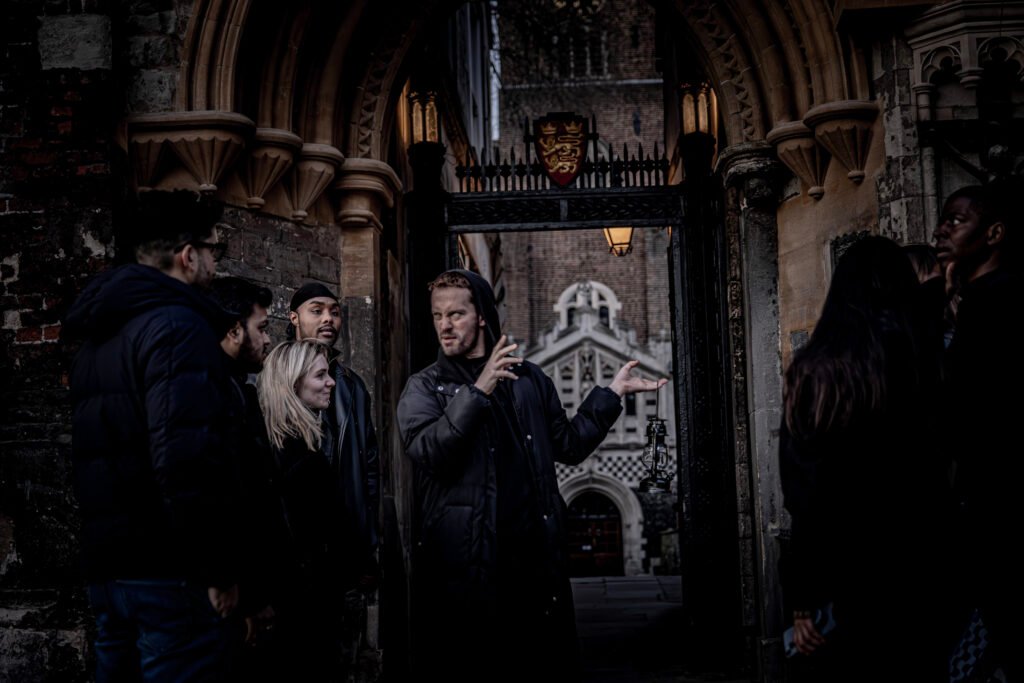
Ghost Tour London covers thirteen historically documented stops across the City of London and Southwark every night at 8PM — max 20 guests, tickets from €25, free cancellation up to 24 hours before departure. This guide covers the route’s history. The tour covers it after dark. Part of the Carpe Diem London After Dark portfolio, alongside the Jack the Ripper Tour in Whitechapel.
Frequently Asked Questions
What is the most haunted place in London? The City of London. Charterhouse Square, West Smithfield, and Clink Street are all connected to confirmed events — plague burials, documented executions, England’s oldest prison — spanning from the 14th to the 18th century.
Is the Tower of London really haunted? Its ghost stories are Victorian legend. Its documented history — 900 years as a prison and execution site, with well-recorded deaths including Anne Boleyn (1536) and Catherine Howard (1542) — is genuinely dark without them.
What is the most haunted cemetery in London? Highgate Cemetery. The West Cemetery requires a guided tour booked in advance. The Highgate Vampire stories are 1970s folklore.
Can I visit London’s most haunted places independently? Yes. Winchester Palace ruins are viewable from Clink Street at no cost. The Tower of London and Highgate Cemetery charge admission. Guided tours provide the context that makes each location legible rather than a place you walk past.